Case study
About Ambrook
Ambrook brings bookkeeping, payments, and business insights into one place, helping America’s family-run businesses build a more prosperous and resilient future. Backed by Thrive Capital, Lachy Groom, and Dylan Field and trusted by more than 8,000 businesses across industries like agriculture, construction, and trucking, Ambrook’s accounting tools empower operators to manage their finances, improve their margins, and remain independent.
Why Niteshift?
By early 2026, Ambrook’s engineering team had already seen investments in AI tooling pay off in spades. They were early adopters of local coding agents, had experimented with local sandboxes for safe autonomous development and had built their own cloud agent, Amos. “Ambrook is one of the most thoughtful organizations we’ve seen when it comes to AI tooling – they experiment with the latest techniques, are discerning about what is driving results, then quickly put the full force of the organization behind that,” says Sajid Mehmood, co-founder and CEO of Niteshift.
Most of the early benefits of AI tooling had accrued to the engineering portion of the organization. Outside of engineering, a few designers were using Claude Code, many folks were using chat interfaces and while Amos could answer questions in Slack using the data warehouse, it couldn’t write code, which meant that large portions of the team were still isolated from building.
Coming out of the 2026 tax season, Ambrook saw a 4x year-over-year increase in signups. With that level of rapid growth, Ambrook made “everyone is a builder” a central thesis to their company strategy and kicked off Momentum Month, a company-wide sprint where everyone on the team — engineers and operators — learned to identify, build, run, and evaluate their own AI workflows and automations.
To meet these ambitions, Ambrook knew they needed to run coding agents in the cloud to solve two problems:
- Engineering velocity – engineers could use git worktrees to manage multiple agents in
parallel, but:
- Their agents stopped working when they closed their laptop
- Inconsistencies in local sandbox configuration made them difficult to maintain, with limited observability into how well isolated the environments actually were
- Agents were bottlenecked on a single dev environment for testing
- Autonomy for everyone – for designers, customer support, and operators, end-to-end dev setup was a substantial barrier, and maintaining it was an ongoing tax.
Ambrook had explored other cloud agent solutions and had considered extending Amos to allow it to code. But Ambrook has a complex software stack where accounting and payments data accuracy was paramount: getting a realistic-enough cloud environment for the agent to meaningfully test its work requires substantial engineering effort. Given Ambrook’s fast growth, this competed with other priorities. “We estimated that we’d have needed at least a month of dedicated time to extend Amos not just to code but to give it the tools it would need to verify its work,” says John Slinkman, an early engineer and tech lead at Ambrook. “Other cloud agents would’ve locked us into a single company’s harness.” Niteshift offered both model and agent independence and a robust set of tools for verifying agentic work, all without having to build it from scratch.
One hour to onboard; one month to everyone shipping
Instead of waiting a month to complete the work required to DIY, Ambrook engineers decided to try Niteshift’s onboarding agent. After asking a few questions about the plan, then working in a loop for about an hour, Ambrook had a working dev environment in the cloud!
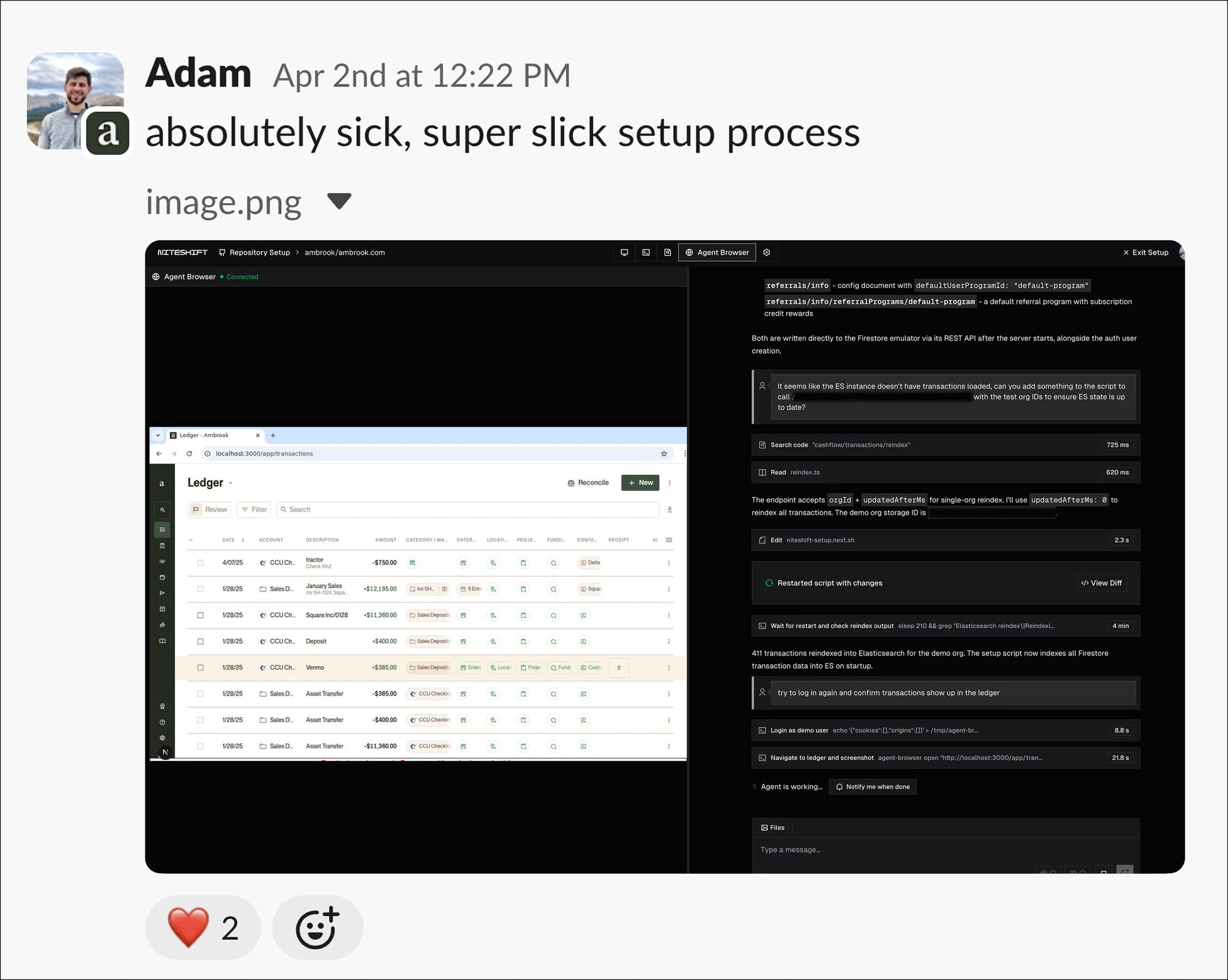 FIG · Ambrook’s cloud dev environment, set up in about an hour
Here’s what’s running inside Niteshift for Ambrook:
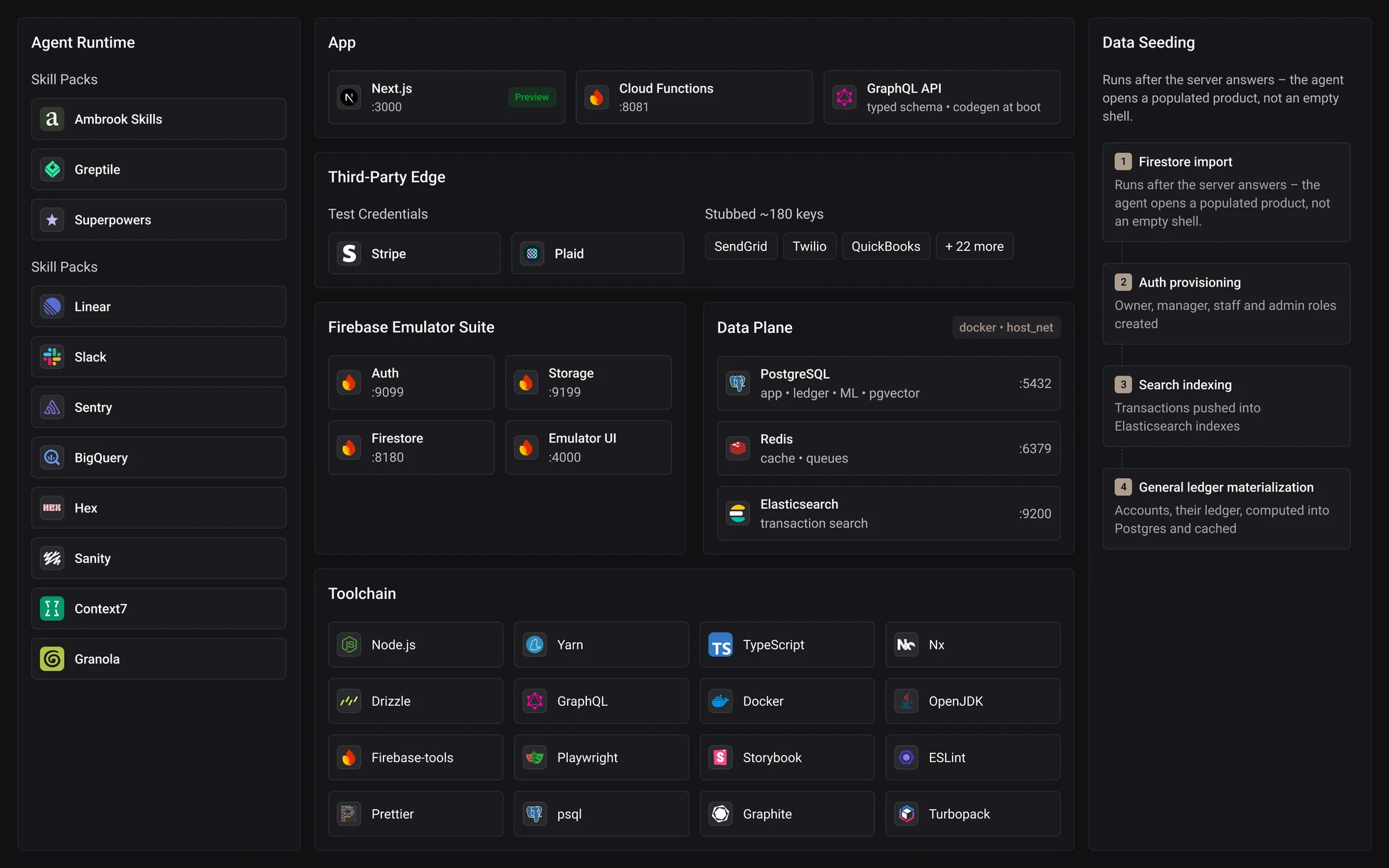 FIG · What runs inside Ambrook’s Niteshift environment
Most of this was set up in the initial onboarding, but as the first engineers began using Niteshift, they continued to make improvements (e.g. adding test credentials for Stripe and Plaid) to make more things testable end-to-end in Niteshift.
After 3 weeks of increasing usage among engineers, Ambrook gave a company-wide training as part of Momentum Month on how to use Niteshift, getting every member of the team shipping to production.
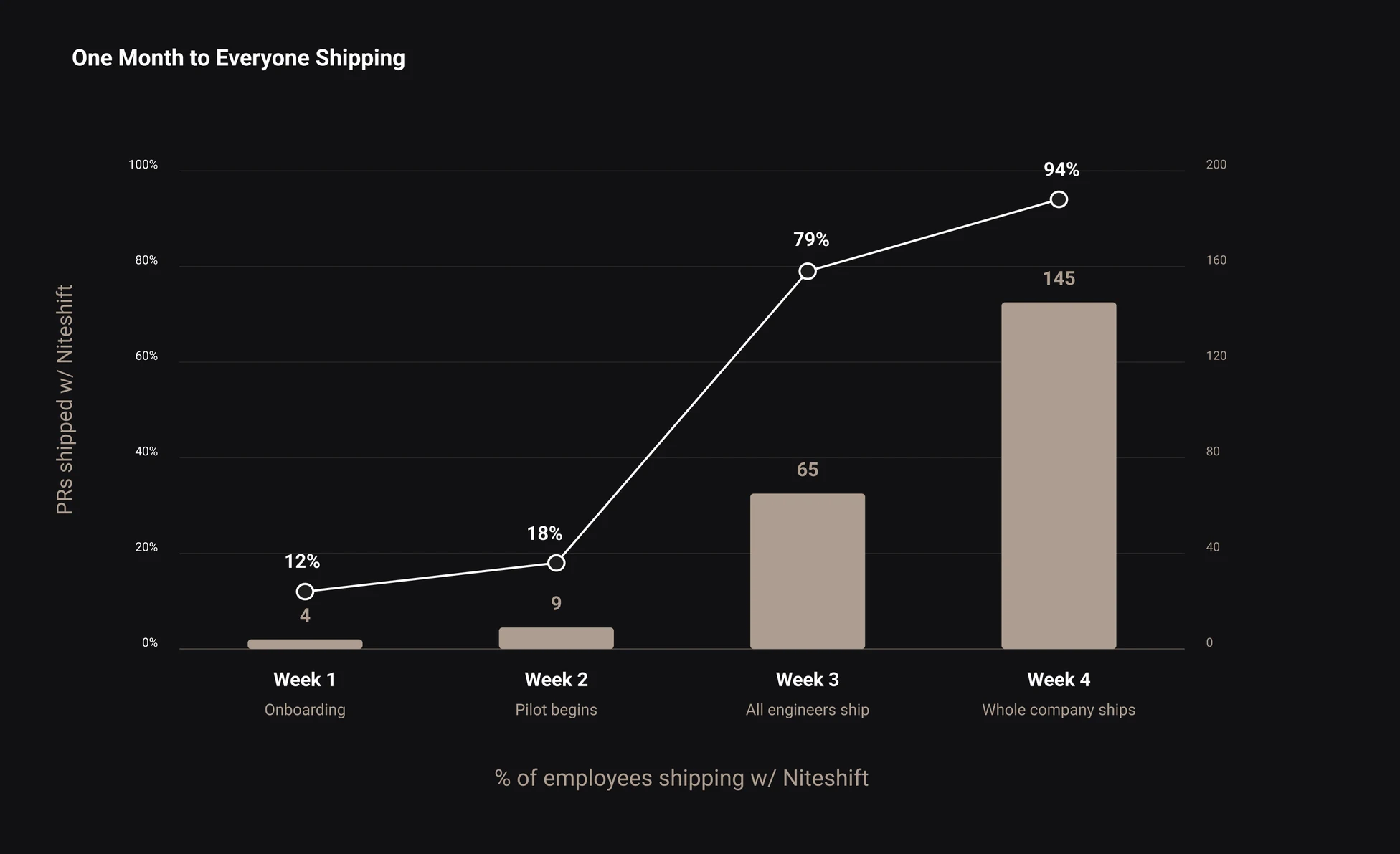 FIG · Niteshift adoption at Ambrook, from 12% of the company to 94% in four weeks
What (and who) ships on Niteshift
Interesting use cases for Niteshift abound at Ambrook. Some engineers have replaced local development entirely with cloud agents while designers who were previously unable to get local development environments up and running are now some of the heaviest users of Niteshift. But Niteshift’s ability to manage sandbox infrastructure, maintain test environments and verify fixes with its in-sandbox browser really shines when embedded into thoughtful engineering practice or specifically designed engineering loops.
Engineering + Design: Migrating Material UI to BaseUI
Ambrook has had a comprehensive design system that, among other things, powers its cross-platform web and native app, with product engineers shipping to multiple platforms with minimal overhead. Over the years, a significant amount of cruft had built up under the hood in the design system and had started slowing design engineers down. Ambrook had known they wanted to migrate off of Material UI to a headless component library that would be a better fit but had struggled to make time against competing priorities. However, when Fable was first briefly available in early June of 2026, Ambrook tried one-shotting a migration to BaseUI — and it worked!
Unsurprisingly, the first pass had poor test coverage, and was a giant, unreviewable PR. Ambrook engineers then decomposed the end-to-end PR into an implementation graph. They had Fable build one example component with Storybook stories and visual regression tests, then parallelized the rest against that pattern using a mixture of Claude Code and Codex Niteshift tasks. Ultimately, the migration took 2 people 4-5 working days, spread out over 2 calendar weeks. They kicked off 58 Niteshift tasks (30 using Claude Code, and 28 on Codex), and merged 29 PRs.
This is an increasingly common engineering practice: use powerful models to prove out a concept and then powerful tools like Niteshift to take the concept to production. Ambrook architected the plan, Fable specced it in detail across a large, complex codebase, and Niteshift executed it using cost-efficient models like Sonnet and GPT-5.6 Luna. The updated design system is live in the product today.
Product Ops + Customer Success: Shipping to production with engineering sign-off
Ambrook’s customer success team often sees small but meaningful product gaps before anyone else. Historically, acting on that insight meant writing a ticket and waiting for it to compete with the existing engineering roadmap. With Niteshift, the support team can scope smaller features and bugs, prompt an agent with an implementation brief, test the result in a preview, and bring engineering a working pull request for final review. This shortens the distance between hearing about a problem and improving the product, while leaving engineers focused on the deeper work required to scale Ambrook.
One recent example comes from a customer request to export a particular view in Ambrook to Excel. The request had been sitting in Linear for 11 months because customers had a workaround and it never rose to the top of the backlog. After hearing the need directly on a customer call, Katie Ellig – who leads Ambrook’s Services team – ran Ambrook’s triage skills over the ticket, added the missing context, and handed the resulting brief to Niteshift. Niteshift implemented CSV and Excel downloads and opened a pull request; Katie tested the preview, and engineering performed the final review. The feature shipped two days after the call.
Ambrook wrote more about how they’ve used AI tools like Niteshift to personalize the customer experience on their blog. Ambrook is not stopping at leaving the operator to drive the agent, however. Both bug fixes and small feature requests now flow through a carefully engineered workflow backed by Linear, Niteshift, and a triage agent. On filing a task in Linear, the triage agent will determine how likely the task is to succeed, either as a one-shot or as a PR requiring a small amount of human intervention to get over the line. It may decide the ticket needs a reproduction or more clear acceptance criteria. It may decide that the ticket is too complicated for an agent to handle at this time, or that it would be more efficient to bring a human in to guide the agent across the line. But if it decides the ticket is agent-ready, it will hand it to Niteshift, which owns reproduction and testing in the cloud environment before a human verifies the fix against a live preview and approves merging it.
What’s Next?
Today, over 50% of Ambrook’s PRs are made with Niteshift. But there are still some kinds of changes that can’t be autonomously verified in Niteshift. For example, there are some third party services Ambrook uses – like payment providers specializing in physical checks – that do not have robust test credentials for end-to-end testing during development. Niteshift is developing an easy way to mock these external services in the cloud environment to enable the agent to test these integrations.
Ambrook is also beta testing Niteshift’s Android and iOS support to enable testing changes across mobile, web, and the backend in a single cloud environment.
With its recent $30M Series B led by Lachy Groom, Ambrook is growing its team a lot. If you’re interested in applying the latest in AI tooling to build the financial infrastructure that independent operators rely on, see their open roles.
Ready to get your whole team shipping on Niteshift?